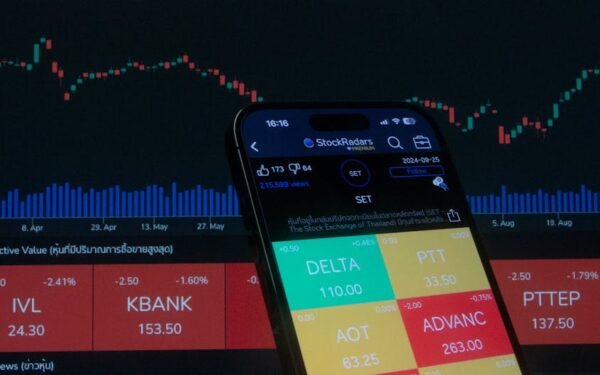
Technology stocks suffered their worst single day of 2026 on Friday, the Nasdaq plunging 4.18% to 25,709.43 as of Friday’s close. The S&P 500 fell 2.64% to 7,383.74, wiping out the gains from a solid Monday when the index touched 7,600. For the week, the S&P lost 2.59%. The Dow? It slipped just 1.35% on Friday to 50,866.78 and ended the week down a mere 0.32%. This was not a broad market rout. It was a rotation, and it was violent.
The sector scoreboard confirms it. Technology cratered 7.90% for the week. Consumer discretionary dropped 2.82%. Meanwhile, healthcare climbed 3.50%, real estate added 3.30%, and utilities gained 2.90%. Consumer staples rose 1.72%, financials edged up 1.69%, and energy eked out 0.65%. The Cboe Volatility Index spiked 39.7% from 15.40 to 21.51 as of Friday’s close. That is elevated, but nowhere near the 30-plus readings that accompany genuine crises. Money flowed out of high-multiple tech names and into sectors that generate earnings and pay dividends. That is a healthy signal.
The macro backdrop reinforced the shift. The 10-year Treasury yield climbed to 4.54% as of Friday’s close, up from 4.47% on Monday, putting pressure on long-duration tech stocks that trade on promises of distant cash flows. WTI crude slipped to $90.54, down from $92.16. Gold fell 2.47% on Friday to $4,365, shedding gains alongside risk assets — a detail that should give pause to anyone calling this a simple risk-off rotation. Bitcoin recovered to $62,805 from a Saturday low of $60,867, suggesting crypto traders saw the equity selloff as a buying opportunity rather than a systemic alarm.
The real risk is not the direction of the rotation but its velocity. A VIX spike of this magnitude in a single session typically requires several days of follow-through before volatility normalizes. If the Nasdaq opens lower on Monday, momentum-driven algorithms and systematic strategies could accelerate the selling. Wednesday brings the FOMC rate decision, and Thursday delivers the May CPI print. Those two events will determine whether this week was a healthy regime change or the first chapter of a deeper correction.
But consider what held. The Dow barely budged. Financials, healthcare, and consumer staples all closed the week in positive territory. The sectors that drive American employment and economic output are not under pressure. A market where utilities and healthcare hit new highs while speculative tech gets repriced is a market maturing, not collapsing. The play for the rest of 2026 is straightforward: own the sectors that make money, and let the hype stocks correct themselves. See the full Yahoo Finance sector heatmap here.