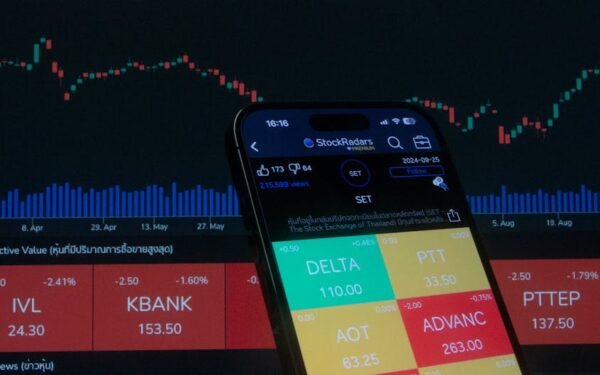
A powerful sector rotation is reshaping equity markets Monday morning as the Israel-Iran escalation accelerates capital flows out of high-growth technology names and into energy, defense, and value-oriented sectors. The Nasdaq Composite’s 4.18% plunge to 25,709.43 on Friday was its worst session since April 2025, and early futures action suggests a continued bifurcation: Nasdaq futures recovered 0.72% on short-covering into a holiday-thinned week, while the broader S&P 500 futures added just 0.34% to 7,425.75, per data from 6:00 a.m. ET on Monday. The Dow futures slipped 0.11%, underscoring the divergent paths the major indices are taking.
The rotation has been most dramatic in Asia, where South Korea’s Kospi index collapsed more than 8% overnight, triggering a trading halt for the first time since 2020. Memory chip giants Samsung Electronics and SK Hynix, which together comprise over 40% of the index, fell 5% and 2% respectively as foreign investors dumped semiconductor-heavy exposure. Japan’s Nikkei 225 closed Friday at 64,024.60, down 3.85%, as SoftBank dropped 6% amid a broad tech retreat that also erased gains from AI-linked names across the region. The Asia session served as a preview of how U.S. markets may digest the dual shock of geopolitical escalation and tech valuation concerns.
Energy stocks are the clearest beneficiaries. The S&P 500 energy sector is indicated to open more than 3% higher following Brent crude’s 4.35% surge past $97 per barrel. Major integrated producers like Exxon Mobil (XOM) and Chevron (CVX) are attracting heavy pre-market volume, while Permian-focused independents such as Occidental Petroleum (OXY) are seeing even sharper interest. The sector’s relative strength stands in stark contrast to the S&P 500’s Friday loss of 2.64%, and the energy vs. tech divergence is the widest it has been since the early days of the Middle East conflict in 2025.
Bond markets are reflecting the shifting outlook as well. The 10-year Treasury yield rose 3 basis points Monday to 4.5741%, while the 30-year bond yield, which is more sensitive to geopolitical risk, gained 2 basis points to 5.0282%, according to data from early Monday trading. Gold slipped 1.10% to $4,317, suggesting some investors expect a diplomatic resolution rather than a full-blown regional war. Bitcoin rose 1.74% to $63,431, continuing its recent decoupling trend from both equities and traditional havens. The message across asset classes is clear: markets are pricing in a prolonged period of elevated geopolitical risk, but not a catastrophe.